Patterns of Life Simulation
We developed a Geo-Social simulation framework
[3,4] based on Agent-Based Modeling
to generate very large, high fidelity, and socially plausible Location-Based Social Network
(LBSN) data. The framework simulates individuals (i.e., agents) who live and
travel in an urban environment. Agents exhibit plausible social behavior which is
based on well-respected psychological and social science theories (e.g., [1,2]). The
agents' needs and preferences guide the choice of locations they visit, which may
yield new friendships, depending on the type of locations where they meet. Following
the underlying spatial network, agents visit specific locations which also results
in emergent travel patterns. Simulation parameters can be adjusted to create social
settings similar to the real-world allowing us to create massive sets of simulated
LBSN data. Such high-fidelity data sets contain all individuals of our simulated
world with certainty while not impacting the privacy of any human subject in the
real-world. As a deliverable, this research yields synthetic LBSN data sets of
hundreds of thousands of users, scaling to years of observed user data, and thus
creating gigabytes of meaningful check-in and social interaction data.
Patterns of Life (PoL) Model
The computational framework creates simulated worlds in which agents move and
interact with the environment and with each other. Our agents have comprehensive
needs and behaviors which result in complex patterns of life, and social networks
and their formation. In addition, each simulation instance of our framework is based
on (real or synthetic) spatial networks with locations and social networks of users.
The agent model logic used to generate the data is constructed based on people's
daily patterns of life (PoL) supported by well-respected psychology and social
science theories (e.g., [1,2]). Each individual is equipped with the first three
levels of the Maslow's [1] Hierarchy of Needs: (1) physiological, (2) safety, and
(3) belongingness and love needs. To satisfy their needs, agents travel to sites on
the underlying road network.

|
| Figure 1. Daily patterns of life |
The most basic and highest prioritized needs are physiological needs, which make agents rent an apartment, eat food at home or at a restaurant when they are hungry, and sleep when their internal circadian rhythm kicks-in according to their individually computed wake-up times. The agents are driven to reduce their physiological needs first. Second-level needs begin with the agent engaging in a process instantiated by the agents as they try to attain financial stability. This second-level drive leads them into a process that begins by them trying to find and keep a job. From there, they seek to have enough income to pay for their own individually desired, temporally projected, and fiscally anticipated (i.e., budgeted) monthly costs in the world. Among the simulated costs we require the agents to pay for things like rent, food at home or in restaurants, education expenses for offspring, and voluntary personal expenses associated with recreation. All costs must be paid for by the individual agent from its own "earned" income. An agent's job and pay scale is dependent on its education level and momentary job market availability. Each agent has a home, can move to a new home, has a job/work location, and may change job/work over time. The underlying logic is that an agent will usually stay in their job and home unless their financial stability is broken due to an unexpected event such as a roommate moving out. In such cases, they either move into a different apartment with a lower cost or switch to a better paying job.

|
| Figure 2. Maslow's hierarchy |
Again, following Maslow's [1] Hierarchy, agents must satisfy physiological and
safety needs first. Only after these needs are met can higher levels of
self-actualization corresponding to belongingness and love (i.e., relationships and
friendships) be computed and executed. When the more basic needs from the hierarchy
are met, an agent may then choose to visit a recreational site for the purpose of
socialization. Recreation sites are figurative "hubs" for socialization. At these
places, agents may meet new peoples, create budding friendships, and or improve
their existing friendship bonds with others. In our simulation, social relationships
are simulated using a weighted and directed "social network." Agents are attracted
to recreation sites because of the agent's individual age, their individual income
level, their own interests and the interests of others who visited the site in
recent times, and their proximity to the site when the decision to visit the site is
taken. When an agent visits a recreational site and has no friends there, there is a
slight chance that the agent will establish a friendship with a stranger (i.e.,
focal closure). This chance slightly increases if the stranger is actually a
friend's friend (i.e., cyclic closure). Thus, co-location (i) increases one's
chances of becoming friends with other people and (ii) to maintain existing
friendships.
However, the lack of co-location, thus the lack of social interaction, decreases one's friendship strength, which may eventually lead to a disappearing friendship. We note that over years of simulation time, the agent's aim is to maximize attributes such as "happiness", which is related to making friendships and "money balance", which is related to job choice. With different agents having different goals, they maximize different attributes. Restaurants are another type of site used by agents to satisfy their physiological needs caused by hunger. Agents who visit restaurants have the chance to meet with their friends without coordination. Such meetings increase the strength of an existing friendship. Each agent has choices, such as preferring a certain type of restaurant, cafe, or bar. The simulation stores and writes spatial and social information for each agent into large, shared log-files which can be processed and analyzed offline.
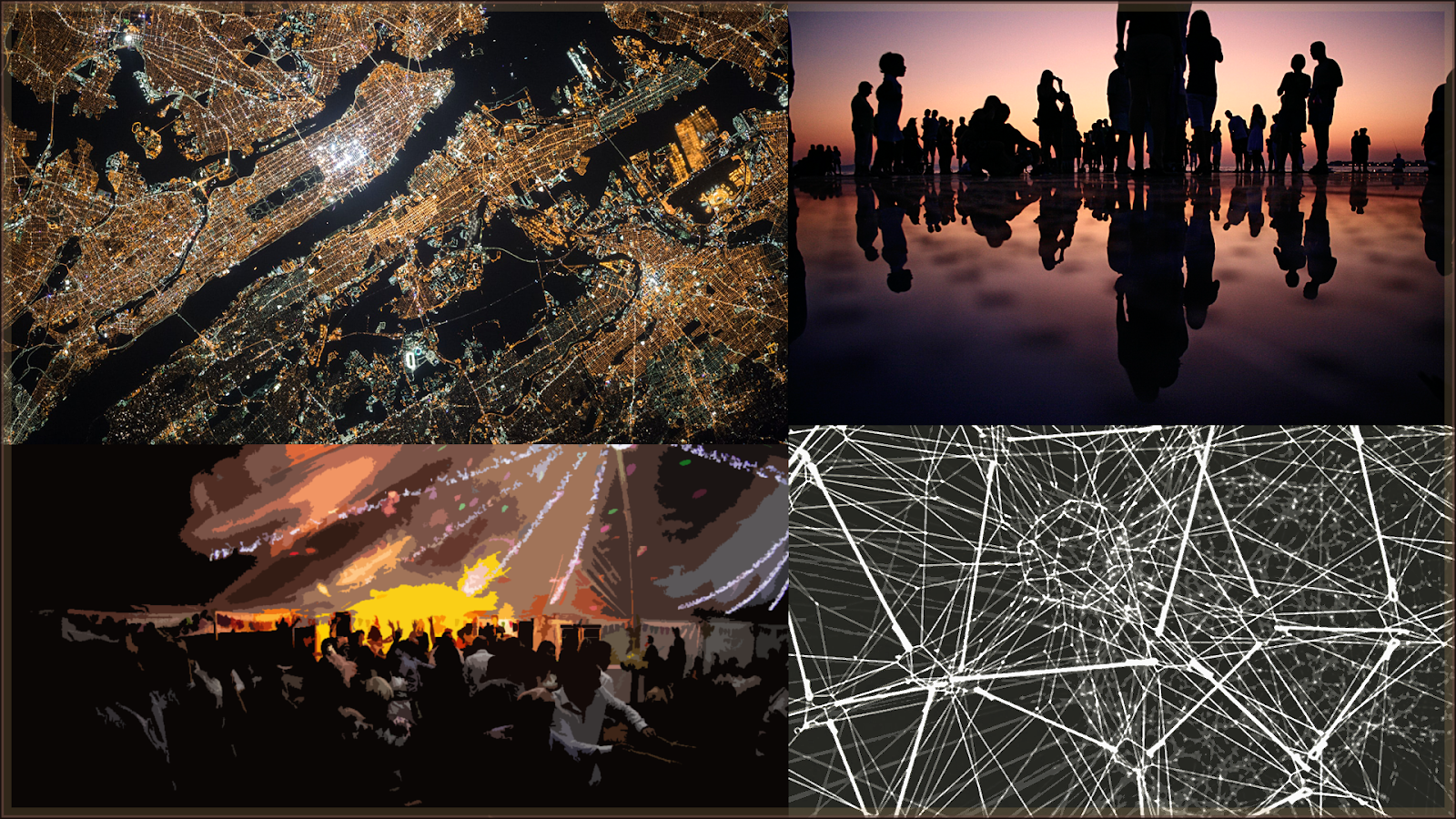
|
| Figure 3. Colocation and social interactions |
However, the lack of co-location, thus the lack of social interaction, decreases one's friendship strength, which may eventually lead to a disappearing friendship. We note that over years of simulation time, the agent's aim is to maximize attributes such as "happiness", which is related to making friendships and "money balance", which is related to job choice. With different agents having different goals, they maximize different attributes. Restaurants are another type of site used by agents to satisfy their physiological needs caused by hunger. Agents who visit restaurants have the chance to meet with their friends without coordination. Such meetings increase the strength of an existing friendship. Each agent has choices, such as preferring a certain type of restaurant, cafe, or bar. The simulation stores and writes spatial and social information for each agent into large, shared log-files which can be processed and analyzed offline.
References
[1] I. Ajzen. The Theory of Planned Behavior. Organizational Behavior and Human
Decision Processes, 50(2):179–211,1991.
[2] A. H. Maslow. A Theory of Human Motivation. Psychological Review, 50(4):370,
1943.
[3] H. Kavak, J.-S. Kim, A. Crooks, D. Pfoser, C. Wenk, and A. Züfle.
Location-Based Social Simulation. In SSTD, pages 218–221, 2019.
[4] J.-S. Kim, H. Kavak, U. Manzoor, A. Crooks, D. Pfoser, C. Wenk, and A. Züfle.
Simulating urban patterns of life: A geo-social data generation framework. In
SIGSPATIAL, pages 576–579, 2019.