- Let X =
x1, x2,
x3, ... xN
be a finite data sequence.
- Let B be the number of buckets
(the value of B is given, i.e., it's a parameter of the
problem formulation)
- The histogram HB is a histogram that
uses at most B buckets.
- The (typical) histogram representation
collapses a sequence values
xs, xs+1,
xs+2, ... xe
into a single point
hr
of the histogram.
- The range from xs to xs forms the bucket
- The point xs is the start point of the bucket
- The point
xe
is the end point of the bucket
- The value
hr
is used as an
estimate
for all the values
xs, xs+1,
xs+2, ... xe
!!!
In other words, after you construct the histogram, when someone asks you:
- What is the value xs+1 ?
Your answer must be based on the histogram and therefore, you will answer:
- the value is hr
- You will incur an error of
hr -
xs+1
to the inquiry of xs+1.
- The expression
hr -
xs+1
canbe positive or negative;
for practical purposes, we prefer expression for
errors that is always positive
(because errors are penalty values
It is common to use |hr - xs+1| (absolute value) or (hr - xs+1)2 as expression for the error.
The expression (hr - xs+1)2 is prefered because it is differentiable .
- The squared error for the values in bucket br
is:
-
SqError(br) =
∑k=sr..er
(hr - xk)2
The following figure shows what this error represents:
- Notice that
SqError(br)
will change when a different value for hr
is used !!!
- One of the problems that we must solve is:
-
What value should hr
be so that
SqError(br)
is minimized

- Notice that
SqError(br)
will change when a different value for hr
is used !!!
- Let EX(HB) be the
total error
between the actual data sequence X
and the histogram HB values:
-
SqError(histogram) =
∑r=1..B
(
∑k=sr..er
(hr - xk)2
)
- Notice that
SqError(histogram)
will change when we divide the domain up into
different bucket ranges (even when we use
the same number of bucket B)
- Another problem that we must solve is:
-
What are the ranges of the B buckets
so that
SqError(histogram)
is minimized
- Notice that
SqError(histogram)
will change when we divide the domain up into
different bucket ranges (even when we use
the same number of bucket B)
- The V-Optimal histogram is the histogram of B buckets Histogram((sr, er, hr), r = 1, 2, .., B) that minimizes the histogram error SqError(histogram)
- It may seem almost impossible to find the histogram that minimizes
the Square Error at first glance, but researchers
have come up with
some very fast algorithm to find the V-optimal histogram.
- Notice that there are 2 subproblems involved in finding the
V-optimal histogram:
- First we have to divide the domain into the "best" ranges, i.e.,
find the buckets (ranges) of the optimal histogram
- Then, for each bucket br, determine the value hr that minimizes the error within that bucket.
- First we have to divide the domain into the "best" ranges, i.e.,
find the buckets (ranges) of the optimal histogram
- We will first deal with the second problem (which is the easiest).
So, let us now assume that the optimum bucket division has been found already (so the bucket ranges are fixed)...
- The expression for the error of the histogram
-
SqError(histogram) =
∑r=1..B
(
∑k=sr..er
(hr - xk)2
)
is in fact the following sum:
-
SqError(histogram) =
∑k=s1..e1
(h1 - xk)2
+
∑k=s2..e2
(h2 - xk)2
+ ...
+
∑k=sB..eB
(hB - xk)2
- If the bucket boundaries do not change, that means
that s1, e1,
s2, e2,
... sB, eB
are constant
- Then the whole sum
-
SqError(histogram) =
∑k=s1..e1
(h1 - xk)2
+
∑k=s2..e2
(h2 - xk)2
+ ...
+
∑k=sB..eB
(hB - xk)2
is minimized if individual sums are minimized.
(This sounds subtle, but if just think how much more complex the minimalization process would be if the boundary was NOT fixed. When the boundaries are not fixed, some values of xk are subtracted from different hr's and we could not make the above statement....)
- Consider one of the sums in SqError(histogram) which is the error made in some bucket br:
-
Sr =
∑k=sr..er
(hr - xk)2
It may be clearer if you write the sum out:
-
Sr =
(hr - xsr)2
+
(hr - xsr+1)2
+
(hr - xsr+2)2
+ .... +
(hr - xer)2
- Each of the x... is constant value, so Sr depends only on hr:
-
Sr =
(hr - c1)2
+
(hr - c2)2
+
(hr - c3)2
+ .... +
(hr - c?)2
- From high school calculus, you must have learned that to find the maximum/minimum of a function, you take the derivative and find the zero.
Since Sr depends only on hr, we find that the derivate is (if it helps, imagine hr to be "x"):
-
S'r =
2 (hr - c1)
+
2 (hr - c2)
+
2 (hr - c3)
+ .... +
2 (hr - cp)
- We find that S'r = 0, when:
-
2 (hr - c1)
+
2 (hr - c2)
+
2 (hr - c3)
+ .... +
2 (hr - cp)
= 0
or:
-
p × hr =
c1 + c2 + c3
+ .... + cp
thus:
-
hr =
(c1 + c2 + c3
+ .... + cp)/p
hr = (xsr + xsr+1 + xsr+2 + ... + xer)/p
- In other words:
- The values that will minimize the error in a bucket is the average value for the items in the bucket.
- Consider one of the sums in SqError(histogram) which is the error made in some bucket br:
- So we have determined that when
-
hr =
(xsr +
xsr+1 +
xsr+2 + ... +
xer)/p
the error made in bucket br is minimized.
- We still need to compute the error itself...
- Before I proceed with the derivation, I want to make a change in
the indices used, it's too clumpsy. I will write hr
as follows:
-
hr =
(x1 +
x2 +
x3 + ... +
xp)/p
- The error made in the bucket br is given by
(see click here) (after replacing
the clumpsy index with 1, 2, 3, ..., p):
-
Sr =
(hr - x1)2
+
(hr - x2)2
+
(hr - x3)2
+ .... +
(hr - xp)2
or:
-
Sr =
(hr2
- 2hrx1
+ x12)
+
(hr2
- 2hrx2
+ x22)
+
+ .... +
(hr2
- 2hrxp
+ xp2)
or:
-
Sr =
p × hr2
- 2hr ×
(x1 + x2 + .... + xp)
+
(x12 + x22
+ .... + xp2)
or:
-
Sr =
p × hr2
- 2hr ×
p × hr
+
(x12 + x22
+ .... + xp2)
or:
-
Sr =
p × hr2
- 2p × hr2
+
(x12 + x22
+ .... + xp2)
or:
-
Sr =
p × hr2
- 2p × hr2
+
(x12 + x22
+ .... + xp2)
or:
-
Sr =
(x12 + x22
+ .... + xp2)
- p × hr2
or:
-
Sr =
(x12 + x22
+ .... + xp2)
- p ×
(x1 +
x2 + ... +
xp)2/(p2)
or:
-
Sr =
(x12 + x22
+ .... + xp2)
-
(x1 +
x2 + ... +
xp)2/p
Now we replace back the clumpsy notation:
-
Sr =
(xsr2
+ xsr+12
+ .... + xer2)
-
(xsr +
xsr+1 + ... +
xer)2/p
- From the above, we know that we must compute Sr
often, and so we must do so efficiently:

- Notice that we have not found the optimal
partitioning of the histogram boundaries yet -
i.e., we don't know the optimal buckets.
(All we know so far is when we are given a certain bucket division of the histogram, we can find the optimal value hr for each bucket).
During the process of finding the B>optimal partitioning of the histogram boundaries, we will need to compute the error value Sr for each histogram, and so we must find a way to compute it efficiently.
- To compute Sr efficiently, we must be able to
compute
the following 2 subrange sums
efficiently:
-
xsr2
+ xsr+12
+ .... + xer2
- xsr + xsr+1 + ... + xer
-
xsr2
+ xsr+12
+ .... + xer2
- You need to maintain the following 2 array of values
- An array P[] where:
- P[1] = x1
- P[2] = x1 + x2
- P[3] = x1 + x2 + x3
- ...
- P[k] = x1 + x2 + x3 + ... + xk
- An array PP[] where:
- PP[1] = x12
- PP[2] = x12 + x2 2
- PP[3] = x12 + x2 2 + x3 2
- ...
- PP[k] = x12 + x2 2 + x3 2 + ... + xk2
- An array P[] where:
- Now, if you can find any 2 subrange sums very easily.
For example:
- x1 + x2 + ... + x30 = P[30] - P[0] (initialize P[0] = 0)
- x5 + x6 + ... + x30 = P[30] - P[4]
- x25
+ x26
+ ... + x78
= P[78] - P[24]
- x12 + x2 2 + ... + x302 = PP[30] - PP[0] (initialize PP[0] = 0)
- x52 + x6 2 + ... + x302 = PP[30] - PP[4]
- x252 + x26 2 + ... + x782 = PP[78] - PP[24]
- Lemma 2 in the paper
click here
shows that any solution using more buckets is better
than one that uses less buckets.
- Lemma 2 says:
- Consider a subrange of number [a..b]
(and the corresponding values
xa, xa+1, ..., xb)
- If we use a single-bucket histogram to represent these
value, the smallest possible error is S[a,b]
- If we use a two-bucket histogram to represent these values,
then we can split the interval [a..b] into two intervals
[a..k] and [k+1..b].
- Lemma 2 says that the combined error of a histogram using any two intervals [a..k] and [k+1..b] (i.e., any k) will be less than or equal to the error of a single-bucket histogram.
- Consider a subrange of number [a..b]
(and the corresponding values
xa, xa+1, ..., xb)
- Proof: come see me if you want to see it.
- While finding the optimal value for a bucket can be solved
using simple calculus, finding the best boundaries for
the buckets require computer science...
- Jagadish et. al.,
presented
a dynamic programming approach
to find the optimal bucket partitioning
in this paper:
click here
- The approach is based on the following idea:
- Suppose we want to find the best histogram
for
x1, x2,
x3, ... xN
that has k buckets
That histogram must use as the last bucket:
-
x?, x?+1,
x?+2, ... xN
We don't know the range of the "best" last bucket.
- No problem, if we try every single possible case:
- Last bucket is: xN
- Last bucket is: xN-1...xN
- Last bucket is: xN-2...xN
- ...
- Last bucket is: x1...xN
we will surely have the bases covered.
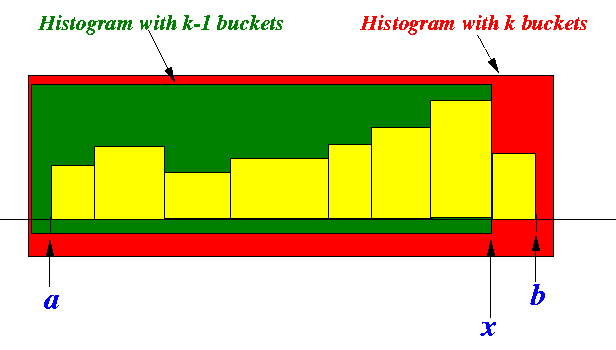
- Furthermore, as the figure above illustrates, a
histogram of k buckets consists
of a histogram of k-1 buckets plus
the last bucket.
So when we try every possible range for the last bucket, the remaining ranges must be covered by an optimal histogram of k-1 buckets.
- In other words, we have the following recursive relationship:
Optimal Histogram for [a,b] using k buckets
= minx=a..b{ Optimal Histogram of [a..x-1] using k-1 buckets + last bucket is [x..b]}
- The procedure given above indicates that:
- In order to find the best histogram for [a..b] using k buckets, we must know the best histogram for every possible subrange [a..x] (x = a..b) using k-1 buckets.
- This type of algorithm is known as dynamic programming -
it is taught in CS171 (I know because I taught CS171 in Fall 2005)
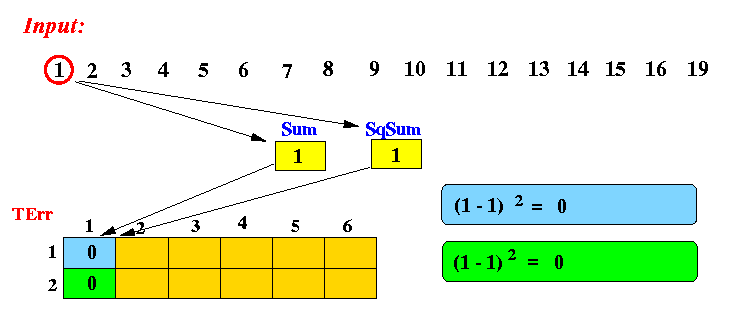
Example: Computes a 2 bucket histogram with the following inputs: 1 2 3 4 5 6 7 8 9 10 11 12 13 14 15 16 19After processing 1 item (1):
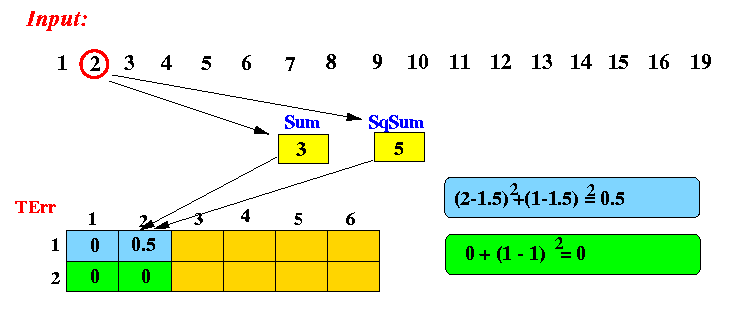
After processing 2 items (2):
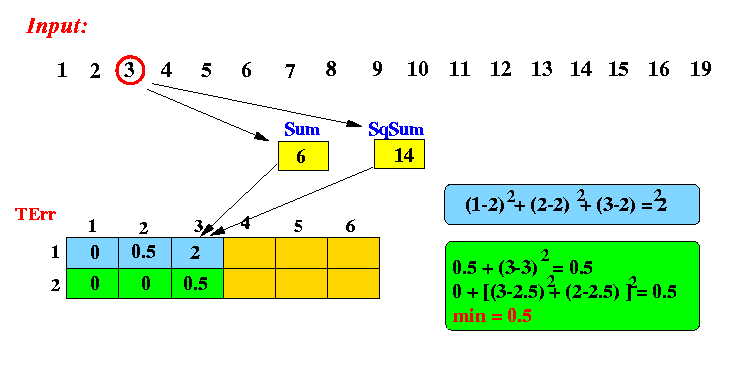
After processing 3 item (3):
After processing 4 item (4):
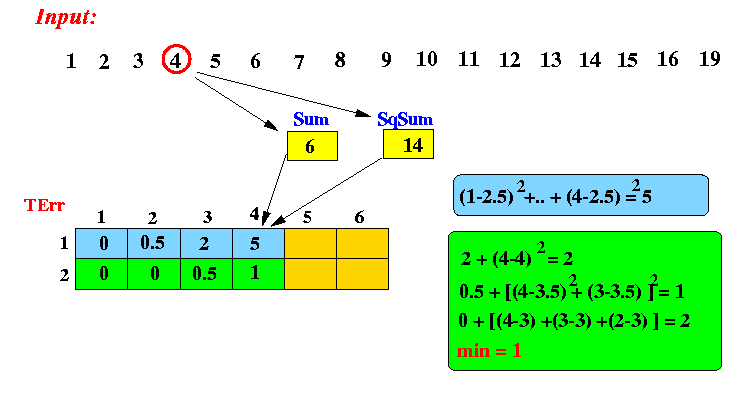
- Here is the algorithm by Jagadish:
Procedure V-Opt BestError[i][k] = best error of histogram using k buckets on (1..i) // Squared Error Function: SqError(int a, int b) { s2 = SqSum[b] - SqSum[a]; s1 = Sum[b] - Sum[a]; return (s2 - s1*s1/(b-a+1)); } // Prepare arrays to compute error efficiently Sum[0] = 0; SqSum[0] = 0; for (i = 1; i <= N; i++) { Sum[i] = Sum[i-1] + xi SqSum[i] = SqSum[i-1] + xi2 } // The dynamic algorithm to find the best histogram // // k = # buckets // i = current item - items processed are: (1..i) for (k = 1; k <= B; k++) { // Find optimal histograms for [1..k] for (i = 1; i <= N; i++) { if ( k == 1 ) BestErr[i][k] = SqError(1,i); // Single bucket (easy) else { // Multiple buckets BestError[i][k] = INFINITE; // Start value // Try every possible last bucket for (j = 1; j <= i-1; j++) // Last bucket is [j..i] { if ( BestError[j][k-1] + SqError(j+1,i) < BestError[i][k] ) { BestError[i][k] = BestError[j][k-1] + SqError(j+1,i); } } } } } - Example Program:
(Demo above code)

- Jagadish's algorithm Prog file: click here
- A version of Jagadish's algorithm that only prints the min. errors:
click here
- Sample input data file 1: click here
- Sample input data file 2: click here